

The H&F Landscape and its evolution
HEALTH & FOOD SUBDOMAINS DIVERSITY
Regarding the RI’s further development, numerous challenges need to be addressed including: food security – ESFRI Project METROFOOD-RI; resilient agriculture and agro-ecological transition – ESFRI Project EMPHASIS; biodiversity, the environment, and marine ecosystems – ESFRI Landmark EMBRC ERIC. The research data created by relevant ESFRI RIs, often managed by the ESFRI Landmark ELIXIR, need to be interoperable with other non-research datasets, such as crop yields, stock levels or geo-location environmental/ecological data. New machine learning and Artificial Intelligence (AI) approaches will increasingly allow for faster and more accurate analysis of datasets and at a greater scale. Data management and interoperability play an important role in connecting the two subdomains of H&F, which cover a very wide range of areas, spanning from fundamental biological science and medical research through biotechnological applications to Agri-food aspects involving also plants genetic aspects. This broad thematic diversity does not feature direct collaborations across the whole RI landscape of H&F. For instance, the ESFRI Landmark AnaEE is primarily collaborating with the ESFRI Project EMPHASIS, aiming at bringing innovative solutions for sustainable intensification of agriculture by integrating the study of plant phenomics and agro-ecology but also with the ESFRI Landmark ELIXIR because of common standards for life science data. On the other hand, the biomedically oriented ESFRI Landmark MIRRI interacts with the Food area, aiming to develop new, safe and healthy food products and the biological management of soils and crops, which connect the Agri-Food subdomain with the Health one.
DEVELOPMENT, ADAPTATION, UPGRADING AND NEW RIs
Over the last 18 years, within the framework of ESFRI and the ESFRI Roadmap process, national governments have worked in close partnership with the European Commission and the scientific community to catalyse the establishment of over 50 European RIs, a key pillar of the European Research Area (ERA). Many of them are mature and operate as Landmarks with established services for numerous research communities, showing a high degree of sustainability. As the whole European research landscape develops together with its research communities, it is now worthwhile to review the initially defined aims and missions of H&F ESFRI RIs and facilitate their further strategic development, refocussing, approach and mission adaptation, or their upgrade. The developmental adaption should follow the gap analysis as well as the development of needs of user communities that are changing, partly following the appearance of new research fields and opportunities or leaving some others. To this end, a continued and focused support of the existing and successful ESFRI RIs might allow them to serve the needs of new and emerging communities. Besides fostering interaction of the established H&F ESFRI RIs, a new RI strongly bringing together environmental aspects in human health appeared on the ESFRI Roadmap - the ESFRI Project EIRENE RI is filling the gap in environmental determinants of health, pioneering the needed knowledge hub on human exosome in EU. H&F ESFRI RIs foresee also interaction with the ESFRI Project EBRAINS which, although a new Digital Research Infrastructure, is based on biomedical knowhow of neuroscience, brain medicine, and brain-inspired technology.
INTRA- AND INTER-DOMAINS CLUSTERING
There is certainly a need to reinforce interactions and collaborations between RIs in Health & Food to exploit synergies and complementarities. The clustering approach of RIs with highly complementary approaches create new added values, allowing the research community to reach more complex and comprehensive goals while acknowledging and allowing that some RI resources and competencies will remain truly unique outliers in the RI ecosystem. One example builds on the Alliance of Medical Research Infrastructures (AMRI)Alliance of Medical Research Infrastructures (AMRI)
https://www.esfri.eu/alliance-medical-research-infrastructures , which could be extended to other existing and future ESFRIs. Such clustering could be also used for refocusing the individual RIs to increase their quality and effectiveness. It is also evident that further intra-domain interactions will be needed to fully address diverse challenges such as cancer or infection diseases as it could be also observed during the recent pandemics crisis. The solutions should consider also inter-domain interactions to include for instance Social & Cultural Innovation, and Environment.
Areas for different RIs interactions are numerous and H&F proceed to develop knowledge and service clusters for research areas including the following examples.
- Human disease challenges, including infections, cancer, rare diseases, metabolic, neurological and other disorders influencing human well-being and ageing.
- Ageing connected to environmental impact on human health, an inter-domain interaction to setup a new directions regarding exposomes and environmental medicine.
- Foods and diets constitute an age-related and geographically diverse exposure matrix that affects health and environmental outcomes across the EU. It is needed to uniquely combine population health and environmental sustainability, the biological and social drivers of food consumption, and foods and diets within the diverse European food systems. Interdisciplinary and multi-stakeholder data, research facilities and innovative tools should become interconnected to synergise the research potential of the heterogeneous European Health & Food land scape. To accomplish this, an interdisciplinary effort is needed, including complementary RIs – e.g. the ESFRI Project METROFOOD-RI, ESFRI Landmark ELIXIR and others.
- Reinforcement of advanced drug discovery, from identifying and characterizing the drug targets, to screening biological activity of compounds to understanding the drug metabolism and biological effects. This requires the European researchers to access technologies and expertise for structural biology, chemical screening, genetics, understanding mechanisms of action at the cellular level as well as at the level of the complex organism using advanced tissue and animal models – e.g. the ESFRI Landmarks EATRIS ERIC, EU-OPENSCREEN ERIC, INFRAFRONTIER, INSTRUCT ERIC, ECRIN ERIC, and the new ESFRI Project EIRENE RI.
- Advancing the marine biology towards environment and medicine by connecting genomics data, with models and image data of marine microorganisms. The ESFRI Landmark EMBRC ERIC supports fundamental and applied research towards sustainable solutions in the food sector, as well as in health and the environment, where it collaborates with other Food and environmental RIs.
- Use of advanced phenotyping technologies including imaging to comprehensively understand plant biology and soil health under changing climate as well as mammals physiological processes in health and disease – e.g. the ESFRI Landmarks Euro-BioImaging ERIC and INFRAFRONTIER, the ESFRI Project EMPHASIS.
- Healthy soils and healthy crops for healthy, safe and sustainable food – e.g. the ESFRI Project METROFOOD-RI.
An overview of the Landscape of the Health & Food domain is given in Figure 1.
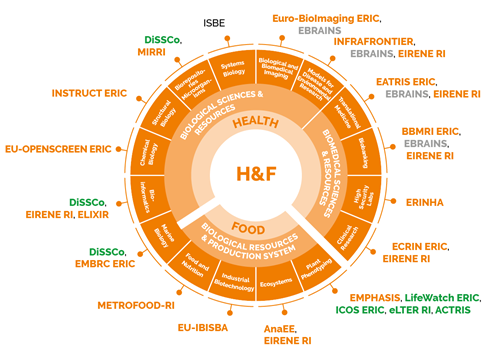
Figure 1.
The Landscape of the Health & Food domain
SCIENTIFIC IMPACT
H&F RIs have increased research and service performance as well as its quality. Their workflows have improved and analyses have been more efficient. Integrated Standard Operation Procedures (SOP) were established, data are better accessible and are being standardised. Besides this, RIs have developed various training and education programs, thus providing users with the necessary skills and competences in a wide range of H&F scope. The RIs disseminate the service-related knowledge, relationship capital (i.e. the benefits of working together such as facilitated knowledge-sharing and cooperation), policy influence (i.e. increased awareness of the benefits of Open Science) and bioinformatics resource uptake. It is becoming clear that the overall economic impact is large and further increases. The RIs have built and established knowledge platforms and cutting-edge technologies for every user in open-access regiment. They especially support excellent research that could not be performed without the existence of RIs. The added-value of the pan-European Health & Food RIs steadily increases with the growing number of users, which could be virtually anywhere in Europe. Thus, ERA becomes true reality. Without additional large investments in an individual European country, the ‘European User’ can find a high-quality solution. Such organisation allows working on complex scientific tasks to solve large European challenges and to improve research efficiency. The impact of the H&F RIs has also expanded internationally through a number of cooperation agreements and building global consortia with related RIs and institutions worldwide.
The European Commission estimates that there are more than 500,000 individuals in Europe involved in some way in life science research and H&F RIs serve substantial part of these user communities, from basic research experts in life sciences and medical professionals to environmental and food domains researchers. The access and service of H&F RIs go beyond the European border and many of them providing services to scientists worldwide directly or through the establishment cooperation agreements and joint initiatives.
SOCIO-ECONOMIC IMPACT
H&F RIs enable leading research to happen while societal and socio-economic benefits impact European society well beyond the RI site. Health & Food RIs influence also industry as a significant share of activities is beneficial also for the private sector. The H&F RIs work to increase awareness of their services exemplified by ESFRI Landmark ELIXIR, which makes public data available to a number of small and medium sized enterprises that have built their business model around these resources.
Technology development is another good example of the socio-economic impacts of Health & Food, in which every RI develops or establishes new technologies and methodologies to move the research possibilities to cutting-edge, which is then used by researchers or even by the private sector. Thus, for instance, by promoting integrative methods, the ESFRI Landmark INSTRUCT ERIC provides peer-reviewed access to state-of-the-art, structural biology technologies and enables excellent science and technological development for the benefit of all life scientists, with strategic relevance and major impact for pharma and biotech companies. The ESFRI Landmark EU-OPENSCREEN ERIC offers its shared resources to users from academic institutes, SME’s, industrial organizations, and facilitates collaborative development of novel molecular tools. ESFRI Landmark EMBRC ERIC, the specialized RI for marine biological resources, provides access to marine resources and cutting-edge services and facilities that allow users from both academia and industry to study the ocean and develop innovative solutions to tackle even societal issues. The ESFRI Landmark INFRAFRONTIER, which created the 3rd largest mouse repository holding more than 6,000 mouse mutants, setups and capitalises the revolutionary technology of genome editing based on the CRISPR/Cas9 technology, which allows to create precise models of human diseases and propose future corrective treatments for many human diseases.
The ESFRI Landmarks AnaEE, as an example from the Agri-Food, enables moving beyond past and current scale- or approach-specific experimental approaches by combining state-of-the-art distributed experimental and analytical platforms with modelling and simulation, of direct relevance for the challenges facing European ecosystems. The ESFRI Project EMPHASIS builds facilities, resources and services for plant phenotyping across Europe, aiming to better understand plant performance and translate this knowledge into application.
According to WHO publication Ecosystems and human well-being: health synthesis: a report of the Millennium Ecosystem AssessmentEcosystems and human well-being: health synthesis: a report of the Millennium Ecosystem Assessment. WHO
http://www.millenniumassessment.org/en/Synthesis.aspx ecosystems are the planet’s life-support systems for the human species and all other forms of life. The causal links between environmental change and human health are complex because they are often indirect, displaced in space and time, and dependent on a number of modifying forces. Thus, preventing the decline in the world’s ecosystems should improve the situation regarding malnutrition, infectious diseases, maternal mortality, exposure to unsafe drinking-water and, most importantly, poverty.
MISSIONS AND CHALLENGES
In Health & Food, each RI has its own specific mission and dedication to particular challenges but there are also common missions. The ESFRI Landmark EATRIS ERIC main mission is condensed in a short statement “Increasing value, reducing waste”, and tackles improvement of new therapeutics development as only 40% of drugs are effectively used worldwide and billions of euros are spent each year to develop new drugs. The mission of new therapeutics and vaccine development also requires the technologies and services provided by the ESFRI Landmarks EU-OPENSCREEN ERIC, INSTRUCT ERIC and INFRAFRONTIER.
One of the most prominent missions is dedicated to cancer which, after cardiovascular diseases, is the leading cause of premature deaths in the EU. In 2016, one quarter (26% corresponding to 1.3 million people) of the total number of deaths in Europe were due to cancer and it was predicted to kill 1.41 million in 2019. The ESFRI Landmarks INSTRUCT ERIC, Euro-BioImaging ERIC, BBMRI ERIC, EATRIS ERIC, ECRIN ERIC, INFRAFRONTIER and ELIXIR will strategically contribute to the new European missionEuropean Mission on Cancer
https://ec.europa.eu/info/research-and-innovation/funding/funding-opportunities/funding-programmes-and-open-calls/horizon-europe/eu-missions-horizon-europe/cancer_en aiming at ‘Conquer-ing Cancer’ as their services are essential in the multiple facet aspects of cancer-related projects, going from understanding to prevention and treatment of cancer.
Another very integrative mission of the H&F RIs is that of protecting human health by increasing Europe’s preparedness for and capability to respond to highly pathogenic infectious threats, for which all RIs of the Health subdomain clustered to provide an effective organization of service provision to address health emergencies.
The RIs of the H&F domain aim to contribute to other Missions of the Horizon Europe Framework ProgramHorizon Europe
https://ec.europa.eu/info/research-and-innovation/funding/funding-opportunities/funding-programmes-and-open-calls_en#horizon2020. With respect to the ‘Caring for Soil is Caring for Life' the ESFRI Project EMPHASIS has a major role in providing access to services that are key for understanding plant performance and translate this knowledge into application. These are complemented with services and technologies of the ESFRI Landmarks MIRRI and AnaEE which, together with the ESFRI Landmark EMBRC ERIC, would also contribute to the ‘Healthy oceans, seas coastal and inland waters’ mission.


