

Astronomy and Astroparticle Physics
Astronomy & Astroparticle Physics (A&AP) seek to understand the Universe and its components: from its still mysterious beginnings to its growing complexity, with the formation and evolution of galaxies, stars and planetary systems, until the emergence of life. The main science questions addressed by the RIs can be summarized as follows:
- understand the origin of the universe, its main constituents;
- understand the extreme conditions the Universe hosts;
- understand the formation of galaxies and their evolution;
- understand the formation of stars and planets;
- search for planetary systems in our galaxy, study the Solar System and extrasolar planets, search for life and understand the conditions enabling life.
The domain relies on a combined approach of observations, theoretical work and modelling, and more and more on laboratory experiments. The level of precision necessary to constrain models requires high-performing space, ground-based and underground observatories, mostly built and managed through international collaboration, and exploited in synergy. Observations of our Universe extend beyond the historical optical domain, to the whole electromagnetic spectrum from radio waves to gamma-rays, and new messengers such as gravitational waves and neutrinos. Multi-messenger astronomy, with its multi-wavelength, multi-instrument approach, is the new frontier to study the phenomena of the Universe and their evolution. Underground physics laboratories investigate the rarest phenomena to discover dark matter and the nature of neutrino mass.
Gravitational wave astronomy is developing. On-going observation of gravitational waves is completed by the first identifications of their source by the detection of electromagnetic and neutrino counterparts, opening a new window for observation. It exemplifies the potency of international and interdisciplinary collaboration, relying on the joint exploitation of VIRGO (EU) and LIGO (USA) data which enables the study of the direction of the signals, whereas the astronomy community mobilizes its telescopes to identify the electromagnetic and neutrino counterpart of the gravitational wave events.
The study of planets from our Solar System through telescope observations, planetary probes and sample return missions, has built up a multidisciplinary field spanning from astrobiology to geology. In recent decades the knowledge of planetary systems outside our own Solar System vastly expanded, with – as of May 2021 – more than 4,300 exoplanets detected from ground and space observations, indicating that our galaxy alone holds 100 billion planets. With the ESFRI Landmark ELT and other forthcoming facilities able to probe the atmospheres of these planets, a new direction in comparative climate science could yield new insights about our own planet’s climate.
The usage of data from multiple telescopes and instruments is now part of the astronomers’ daily life. Another example of a significant result obtained by international collaboration involving several instruments is the imaging of the central black hole of a galaxy by the “Event Horizon Telescope”, a very long baseline array which comprises millimetre and submillimetre-wavelength telescopes separated by distances comparable to the diameter of the Earth, including IRAM telescopes in France and Spain, APEX and ALMA in Chile, in which European participation is secured by ESO.
The key contribution of space missions is illustrated by the map of the positions of 1.7 billion galactic stars and the radial velocities of 7 million of them by the Gaia satellite, which is triggering a number of follow-up observations with ground-based instruments. Solar Orbiter, launched in February 2020, will provide an unprecedented detailed close look at the Sun.
The science drivers of Astronomy & Astroparticle Physics merge with those of Particle & Nuclear Physics, linking the physics from the infinitely large to the infinitely small, giving a holistic rationale for the overall Research Infrastructure investment in the Physical Sciences and Engineering field. This is exemplified by the extension of the Astronomy & Astroparticle Physics community gathered in the ASTERICS cluster to Particle Physics in ESCAPE.
Current Status
European Astronomy & Astroparticle Physics continue to occupy a world-leading status as a result of a strong portfolio of intergovernmental, multi-national and national Research Infrastructures available to the community. The community is strongly organised at the European and national levels, with two bodies dealing respectively with the Astronomy & Astrophysics and the Astroparticle Physics strategy, ASTRONETASTRONET
https://www.astronet-eu.org/ and APPECAPPEC
https://www.appec.org/. ASTRONET, which started as an ERA-NET, is now a self-sustained group of funding agencies and associated bodies. The last update of their Infrastructure Roadmap was in 2015; they are establishing a new Science Vision and Infrastructure Roadmap up to the 2030s, which is expected to be published in 2021. The Astroparticle Physics European Consortium APPEC, which was created in 2012 following the preparatory work of the ASPERA ERA-NET, launched its European Astroparticle Physics Strategy 2017-2026European Astroparticle Physics Strategy 2017-2026
https://www.appec.org/roadmap in January 2018.
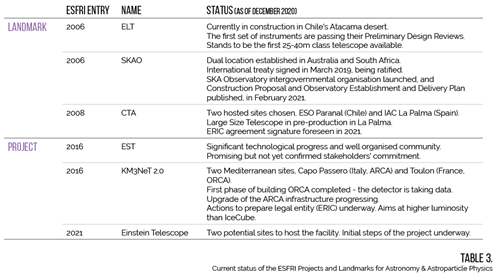
These European-level community-driven roadmaps coupled with the planning processes convened by ESO and ESA, have provided strategic coherence and continue to be implemented. Ground-based telescopes continue to deliver new science. ESO’s Very Large Telescope/Interferometer (VLT/I) is the world-standard, recently contributing to the 2020 Nobel Prize in Physics. The ALMA millimetre/sub millimetre array in the Atacama Desert (Chile), the largest such facility in the world, is in full operation. The International LOFAR Telescope (ILT) and the Joint Institute for VLBI ERIC (JIVE) in the European Very Long Baseline Interferometry (VLBI) Network are pathfinders for the ESFRI Landmark SKAO and international infrastructures on their own. High-energy gamma-ray Cherenkov telescopes HESS and MAGIC developed the observation of TeV scale photon sources into a full-fledged astronomy, and are pathfinders for the ESFRI Landmark CTA. The current status of the ESFRI Landmarks and Projects in the Astronomy & Astroparticle Physics domain is summarized in Table 3.
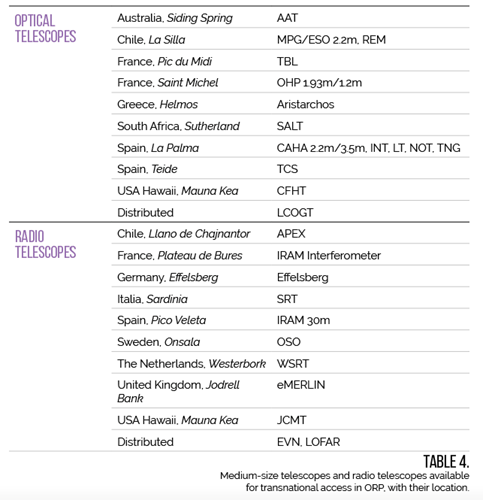
Transnational access to national or multinational astronomical facilities – medium-size optical telescopes and radio telescopes – is organised through the H2020 programme OPTICON-Radionet-Pilot (ORP), which followed the successful EC-funded OPTICON and Radionet networks starting in March 2021 and will continue to develop synergies among activities in the communities (Table 4).
Gaps, challenges and future needs
The lifetime of present-day scientific instrumentation and large telescopes exceeds the natural evolution timescales of the science cases that motivated them in the first place. The original science case often evolves in substantial ways by the time the facility becomes scientifically productive. Thus proposed new projects usually have broad science cases covering several fields of (astro/particle) physics that ensure their continued interest over their expected operational lifetime. The programme of development of new facilities is principally on track, but timelines get longer as the cost and complexity of projects increase.
The evolution of Astronomy & Astroparticle Physics projects clearly goes towards internationalisation in the construction as well as the operation of Research Infrastructures. ALMA and the ESFRI Landmark SKAO have been the first global astronomy infrastructures. Moreover, RIs may work in close collaboration and international networks can be set up to deal with key subjects, for instance, for the follow-up of gravitational events. Ground-based observations can play an essential role in the scientific exploitation of space observations.
The development of time-domain astronomy will be boosted in particular by the advent of the 10-year Legacy Survey of Space and Time (LSST), a US-led project with participation from several European countries. The novel multi-messenger paradigm incorporates follow-up observation and interpretation of transient phenomena alerts by a network of telescopes and underground or underwater/ice detectors. Particularly relevant projects for the observation of gravitational waves are the Laser Interferometer Space Antenna (LISA) selected by ESA as its third Large Mission, foreseen to fly in the early 2030s, and the ESFRI Project Einstein Telescope (ET), which is proposed as the European Third-Generation Gravitational Wave Observatory with a significant increase in sensitivity.
The study of the planets from our Solar System and other planetary systems in our galaxy, and the conditions enabling life, builds up as an inter/multidisciplinary field, using a variety of techniques, complementary ground- and space-based observations, the Solar System studies including landers and sample return. A key topic for the future is the search for early life signature in exoplanet studies, the expansion of astrochemistry to this field and the development of astrobiology.
State-of-the art back-end instruments are essential to ensure the optimal science return of RIs. Instrument development can lead to technological advances shared with the private sector. The long time span of RIs requires instrument suites to be developed with complementarity and technological advances in mind. For instance, the lessons learnt from the on-going development of the first generation of the ESFRI Landmark ELT instruments will have to be taken into account for the next one. Several generations of cameras are also expected for the ESFRI Landmark CTA.


