

Current Status
The digital aspect of the currently most prominent SCI ESFRI Landmarks and ESFRI Projects is outlined below to testify the progress in the use of digital techniques throughout SSH research methodologies.
Scientific databases are a crucial part of the pan-European Infrastructures and more generally in the global science system. Effective access to research data, in a responsible and efficient manner, is required to take full advantage of the data and the possibilities offered by the rapidly evolving digital technology. Accessibility to research data is an important condition for maximising the research potential of new digital technologies and networks. An open and democratic access policy not only provides scientific advantages to the whole academic community, it also provides greater returns from public investments in research activities.
An Infrastructure provides a technology platform, creating a whole range of tools and services that make and represent new knowledge, new resources, for a range of stakeholders generating opportunities for growth, challenge and engagement, for sustainability and for the innovative catalysis of ideas. Creating meaning and knowledge work are central to these mechanisms for sharing, with a foundational interoperability as standard. Research Infrastructures widen participation and strengthen the European Research Area.
The ESFRI Landmark CESSDA ERIC is a distributed Research Infrastructure that brings together social science data archives across Europe, with the aim of promoting the results of social science research and supporting national and international research and cooperation. CESSDA brings important added value to national data archives through providing a central data catalogue, a platform to jointly develop new user friendly tools and services, training especially in research data management, building trust in data through ensuring data quality and standards on how to archive and re-use data. CESSDA also plays an important role to integrate social science data archives into the European Open Science Cloud (EOSC) in the coming years.
The ESFRI Landmark ESS ERIC is an academically driven long-term cross-national survey that has been conducted across Europe since its establishment in 2001. Every two years, face-to-face interviews are conducted with newly selected, cross-sectional samples to chart and explain the interaction between Europe’s changing institutions and the attitudes, beliefs and behaviour patterns of its diverse populations. Based on open calls and a scientific evaluation procedure, the core module is complemented with changing rotating modules to allow new topics to be included into the study. In total 10 rounds of data have been collected with up to 30 European countries participating in each round, round 11 is in the fieldwork phase in 2021. ESS had more than 170,000 registered users and ESS data has been downloaded 130,000 times by 2021 and therefore ESS is one of the most widely used Social Science projects worldwide.
The ESFRI Landmark SHARE ERIC is a Research Infrastructure for studying the effects of health, social, economic and environmental policies over the life-course of European citizens and beyond. SHARE collects multidisciplinary and cross-national survey panel data on health, socio-economic status and social and family networks of individuals aged 50 or older (biennial survey waves). Starting in 2004, 480,000 face-to-face interviews with 140,000 individuals have been collected in 29 countries over 8 waves by now. SHARE has more than 12,000 users from many different disciplines by 2021.
The ESFRI Landmark CLARIN ERIC via CLARIN’s Virtual Language Observatory (VLO) provides easy and sustainable access to digital language data – in written, spoken, video or multimodal form – and advanced tools to discover, explore, exploit, annotate, analyse or combine them, wherever they are located. CLARIN makes these data, tools and services available to scholars, researchers, students and citizen-scientists from all disciplines, especially in the Humanities and Social Sciences, through single sign-on access. CLARIN offers longterm solutions and technology services for deploying, connecting, analysing and sustaining digital language data and tools. CLARIN supports scholars who want to en gage in cutting edge data-driven research, contributing to a truly multilingual European Research Area.
The ESFRI Landmark DARIAH ERIC aims to enhance and support digitally-enabled research and teaching across the Arts and Humanities. DARIAH is a network of people, expertise, information, knowledge, content, methods, tools and technologies from its member countries. It develops, maintains and operates an infrastructure in support of ICT-based research practices and sustains researchers in using them to build, analyse and interpret digital resources. By working with communities of practice, DARIAH brings together individual state-of-the-art digital Arts and Humanities activities and scales their results to a European level. It preserves, provides access to and disseminates research that stems from these collaborations and ensures that best practices, methodological and technical standards are followed.
The ESFRI Landmarks CLARIN ERIC and DARIAH ERIC have collaborated on the relaunch of the Digital Humanities Course Registry.
The ESFRI Project E-RIHS supports research on heritage interpretation, preservation, documentation and management. It connects researchers in the humanities and natural sciences and facilitates a trans-disciplinary culture of exchange and cooperation. E-RIHS will enable the provision of state-of-the-art tools and services to cross-disciplinary users and communities. It aims at the advancement of knowledge about heritage and the division of innovative strategies for its preservation. E-RIHS joined the ESFRI Roadmap in 2016, and is currently working towards reaching the Implementation Phase.
The ESFRI Project EHRI joined the ESFRI Roadmap in 2018 and is currently transforming itself from a project into a permanent organisation that will help secure the future of trans-national Holocaust research, commemoration and education. EHRI will undertake all the necessary legal, financial and strategic work to have this permanent organisation fully operational by January 2025, the 80th anniversary of the liberation of Auschwitz..
The ESFRI Project GGP provides scientists and policy makers with high quality and timely data about families and life course trajectories of individuals to enable researchers to contribute insights and answers to current societal and public policy challenges. The GGP survey focuses on inter-generational and gender relations between people, expressed in care arrangements and the organization of paid and unpaid work. GGP is run by social scientists and National Statistical Offices.
The ESFRI Project GUIDE is a pan-European comparative birth cohort survey including a sample of new born infants as well as a sample of school age children. Both cohorts will be surveyed using a common questionnaire and data collection methodology at regular intervals until the age of 24 years. The Research Infrastructurewill be an important source of high quality longitudinal statistical evidence to support the development of social policies which will enhance the well-being of children, young people and their families across Europe.
The ESFRI Project OPERAS is a distributed Research Infrastrusture enabling Open Science and upgrading scholarly communication practices in the Social Sciences and Humanities in line with the European Open Science Cloud. OPERAS’ aim is to make Open Science a reality for research in the SSH and achieve a scholarly communication system where knowledge produced in the SSH benefits researchers, academics, students and more generally the whole society across Europe and worldwide, without barriers.
The ESFRI Project RESILIENCE is an interdisciplinary scientific Research Infrastrusture for all Religious Studies, building a high-performance platform, supplying tools and access to physical and digital data to scholars from all scientific disciplines. RESILIENCE primarily serves the academic community, but at the same time its impact extends significantly to the non-academic community: an innovative approach for building a European response to the challenges of diversity of religion.
An overall representation of the Landscape of the Social & Cultural Innovation domain in provided in Figure 1.
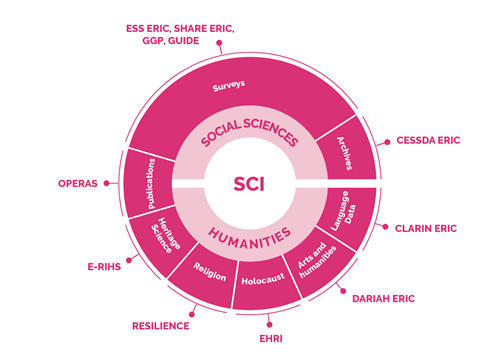
Figure 1.
The Landscape of the Social & Cultural Innovation domain


